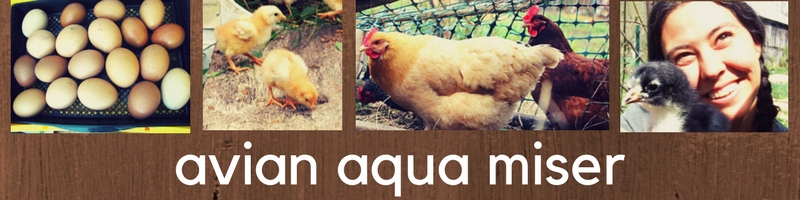
With ingenuity and smart application of Internet-marketing, a couple
in
rural Virginia has managed to stay on the farm, and get away from it
occasionally too.
![Avian Aqua Miser]()
A
hen sips from the Avian Aqua
Miser in Scott County, Virginia. The Miser
has been a generous boost to a farming couple who dreamed it up,
designed it and are marketing it from home.
The chickens on Mark
Hamilton and Anna Hess’s farm in Scott
County, Virginia, don’t fear humans. “We’ve spoiled them,” Hess
says,
with an almost maternal headshake. Not long after Hamilton and
Hess
first bought their 58-acre farm, a friend gave them chickens hoping for
a share of fresh eggs. What followed—thanks to innovative
thinking and
high-speed Internet access—are an invention that has sold all over the
world, a model for rural economic development, and a self-sustaining
farm where the chickens feel spoiled.
Scott County was once a
hub for big tobacco farms, and its location—nestled between two
coal-rich areas—provided an opportunity for residents to work in the
mines. Once income from the tobacco industry and the coal
companies
dried up, however, the county suffered. The population has been
shrinking since 1990, and over twenty percent of the residents live
below the poverty line. Filling the void these tobacco farms left
are
small self-sustaining farms. With small farms come small-farm
problems.
For instance, Hamilton and Hess needed to provide
water for their chickens. Leave too much water and it becomes
dirty
and unsanitary. Leave too little and you can never get away from the
farm; the chickens would go thirsty.
Mark Hamilton artfully
solved this problem with an invention he calls The Avian Aqua Miser: a
nipple on a plastic container that allows chickens to drink the water
only as they need it, a drop at a time.
“At first, I didn’t
know what I was doing,” Hamilton says, referring to an aborted
prototype of his invention. He then noticed that larger
commercial
farms had been doing something similar. But “big industrial farms
overlooked the small guys, the people who only had one, two, three
chickens,” he says. “It didn’t seem right that people had dirty
chicken water. We wanted to help them out.”
Hess and Hamilton
knew they had a winning idea. But how could thy sell it? “People
told
Mark, ‘Go down to the Farmer’s Market, sell it that way,’” Hess
said.
“That means you have to haul it down there, set up a booth, and stay
there constantly,” almost are stifling as never being able to leave the
farm.
“But the Internet is at the booth all day,” Hess laughs,
as she’s making a serious point. By selling the “Miser” on the
Internet, “We were able to pay ourselves a living wage, not just
minimum wage. That’s hard for a lot of people around here to do.”
High-speed
Internet service became available in their part of Scott County three
years ago, and Hamilton and Hess signed up right away; they pay $29.95
per month through Scott County Telephone Cooperative. And because Hess
and Hamilton have high-speed Internet access, they have been able to
sell the Avian Aqua Miser to all fifty states and as far away as
Greece, Australia, and Japan. In today’s economy, having a good
commercial idea isn’t enough—you need to market it. That means
finding
your customers, even if they’re on the other side of the world.
“We
thought it was only going to sell to farmers,” Hess says. She was
pleasantly surprised to find that all sorts of people wanted to buy it,
even city-dwellers, thanks to the urban homesteading movement.
Most
everyone agrees that high-speed Internet access is advantageous to
rural areas, but how should it get here? Many Internet providers
don’t
think it’s profitable to cover remote areas where the houses are spread
apart and the people don’t have much money. In response, Hess
tells of
two friends, a married couple from Colorado. “These were just the
sort
of people the Chamber of Commerce would want to move here.
Well-educated, good money. But there’s no way they’d relocate to
a
place without high speed Internet. …We had broadband, so they came.”
![Hess and Hamilton]()
Mark Hamilton
and Anna Hess at their 58-acre farm. “We think it’s paradise here,”
Hess says of southwest Virginia.
Now, Hess says, her friends
go out of their way to support local
businesses and the community at large. The point, she implies, is
that
investing in rural communities eventually pays for itself. By
using
broadband, Appalachians can sell their ideas, their products, and their
work. “We can move from being an extractive economy to a productive
one,” she says. “We can have more ways of making money than by chopping
down our mountains for coal.”
Hess emphasizes that high-speed
Internet access allowed them to start a business with almost no
resources. “When we started we were on a shoestring budget.
Less than
a shoestring.” The couple had only five hundred dollars in the
beginning. They hope to serve as models for Appalachian youths
with
ideas and to show those who think they have to leave home to be
successful that’s not true. “Work for a summer, you can make five
hundred dollars.” Hamilton says. “If you have enough desire,
that’s
all the money you need to get started.”
“We’re not looking to
get rich,” Hess says, “but we wanted to make enough money to keep body
and soul together.” Their invention has offered them economic
freedom
to devote their time to what they really love—their farm.
Hess
grew up on the outskirts of Bristol, and she felt connected to the
Appalachian land from a young age. “We moved away from a farm
when I
was too young to do the hard work. The farm to me was eating
great
tomatoes, playing in the woods. We moved to the city, and all I
could
say was ‘Mom, where are the great tomatoes?’” The biological
diversity
of the area kept her close. “Here we are land-rich even when
we’re
money-poor.”
Mark Hamilton took a more circuitous route to
Scott County. From Ohio originally, he moved around the country,
setting up camp as far away as Albuquerque and Boston. “I was
kind of
a drifter,” he says. Hamilton speaks slowly, careful with his
words.
“I was looking for something, and I guess I found it.”
“We think
it’s paradise here,” Hess says, waving her arm around to indicate
either the farm, Appalachia, or both. “The people who leave the
mountains, they still think it’s paradise, but they don’t think
there’re any jobs or opportunities.”
With innovative ideas, and the right tools in place, maybe locals won’t
have to decide between paradise and their daily bread.
Willie
Davis is a writer and teacher from Whitesburg, Kentucky, whose work
been featured in The Guardian, The Kenyon Review and on WMMT radio.
This
article was first published in Daily
Yonder.